* I started writing this post on Tuesday, so it counts. pbbbth.
"There's no need for argument, there's no argument at all..."
- Van Morrison
True story:
Whiskeyjack is in the slings, just about ready to get wet (which is not nearly as kinky as it sounds). Rod, the crew I had shanghai'd to help get her into her slip was busy gearing up, inventorying and loading the boat, while I was hanging canvas or drinking beer or something equally vital, and asked me,
"Where's your paddle?"
Paddle?
"You need one aboard to be legal on a boat this length, don't you?"
Hmmmm. Good question, and frankly (to my chagrin) I didn't have the answer off the top of my head.
I thought back a few seasons:
Whiskeyjack didn't have one when we bought her.
I'm pretty anal about making sure we meet the letter of the boat safety equipment law, and didn't add a paddle to her stores when we outfitted her for our first season, all those years ago.
So, here we are today, paddle-less. I was pretty sure we did not need a paddle to be legal.
Pretty sure.
But not positive.
And I couldn't explain why I was pretty sure.
I said as much.
Rod jogged home and grabbed a paddle.
(Rod lives enviably close to the boat yard.)
Splash Day usually sees Whiskeyjack getting hull-wet in a pretty stripped down state. minimum equipment, virtually zero stores.
No books other than manuals and logs.
If I had had my Boater's Pocket Reference handy- I could have saved Rod a trip:
We don't need a paddle, because we have an anchor.
Thomas McEwen has compiled a clever little compendium of boating knowledge that should be aboard every boat. While small in format, capable of fitting in a drinkholder,
this mini-doorstop clocks in at 800ish pages of valuable information.
Everything you could want or need to know about recreational boating regulations, seamanship, boat handling, and boats, of both the wind and fossil powered species, is in here.
The difference between a ketch and a yawl? It's in here.
VHF channel frequencies and designations in the US and Canada? It's in here.
How to tie over a dozen knots? It's in here.
Customs and Immigration info for USA and Canada? It's in here.
Pre-departure, maintenance and general winterizing checklists? It;s in here.
Anchor sizing charts and anchor options for bottom conditions? Yep, it's in here.
This little book is a Dock discussion go-to resource and has settled numerous beer bets.
F'rinstance: If a vessel is using signal flags, what does displaying the "M" flag indicate?
Page 601 has the answer.
All of it is written in a clear, easy-reading style that isn't too jargon-heavy for the novice and also not too dumbed-down for the old salt - a rare feat.
First published in 2006, some of the information, such as web addresses and telephone numbers listed in the appendices, is out of date. It would be nice to see a revised edition, but the vast, vast majority of the info contained is still relevant. If you really need a web address and the link in the book is dead, the publisher has an excellent website with updated links . They also have downloadable versions of the checklists in the book, a great bonus.
Sure, lots of this info is available in a variety of other publications, as well as on the web, but never has this depth and breadth of info been available in a package this compact... that doesn't rely on an internet connection.
As the author writes in the forward:
"The book ended up containing all the info I would have liked to have had, all in one place...."
Available from all of the usual suspects, or direct from the publisher .
"Talk The Dock!"
The adventures of the merry band of misfits who call Dock Six in Port Dover their summer home. Boat repair, boat maintenance, boat building, boat cruises, boat philosophy, boat recipes and just plain boats are the focus, fueled by good food, good friends and cheap booze. Welcome!
Showing posts with label books. Show all posts
Thursday, 20 June 2013
Tuesday, 28 May 2013
Book Reviewsday Tuesday: The Living Great Lakes
"Lake Huron rolls, Superior sings
in the rooms of her ice-water mansion.
Old Michigan steams like a young man's dreams;
the islands and bays are for sportsmen.
And farther below Lake Ontario
takes in what Lake Erie can send her..."
-Gordon Lightfoot
The Great Lakes are, collectively, trillions of gallons of freshwater awesome. Superlatives are the descriptive standard- biggest, longest, deepest, largest, best, most.
These Lakes of ours are epic.
Some in-your-face Lakes trivia:
The coastline length of the Lakes exceeds the lengths of the Atlantic and Pacific coastlines of the United States. Combined.
The surface area of the Lakes exceeds the states of New York, Connecticut, New Jersey, Massachusetts, New Hampshire and Rhode Island. Combined.
The Lakes encompass two countries and straddle two time zones.
The Great Lakes contain 5% of the standing fresh water on the entire planet.
Individually, the five lakes bear little resemblance, one to another, and if it wasn't for the tie of shared waterflow, one would be hard pressed to create any sort of logical connection.
Without shared water, what possible commonality could deep cold Superior and shallow, warm Erie share, being separated by hundreds of miles and five degrees of latitude?
This vast scope and individuality are what make a narrative condensation of the Lakes such a daunting task, and why it runs the risk of resulting in a tome written in the spirit of the Jain/Buddhist/Hindu parable of the blind men seeing an elephant:
The small picture is captured while the whole is discarded, the scale lost, distorted or just plain ignored.
Which may be why few writers have attempted the task. It is Micheneresque in scale, and Michener has sailed across the bar.
Jerry Dennis took on the challenge.
And conquered it.
The result, The Living Great Lakes: Searching for the Heart of the Inland Seas , is a solid success that sets the standard.
-cover image courtesy of McMillan Publishing
Five Lakes, each with her own unique geology, ecology, politics, geography, history, climate, sociology, economy and hydrology.
Enough for five hefty textbooks that nobody would want to read.
How the hell does a writer capture each Lake, and further capture the Lakes as a whole?
Dennis went sailing, and this narrative device transforms what could have been a dry academic compendium of facts into a compelling and enjoyable read.
The author signed on as crew on the delivery of the Malabar, a ferro-cement sightseeing schooner being relocated from Lake Michigan to Maine. This journey allows us to see the Lakes through the author's eyes, and each port of call and waypoint is the prompt for an anecdote, a history lesson, a flashback to an event in the author's past, or an interview with a local character, like Long Point's now-deceased beach comber/historian Dave Stone.
Jerry Dennis grew up on the Lakes, lives on the Lakes, has sailed and fished and swum and dived and camped and canoed on the Lakes, and his love and his background shows. He gets it.
He gets that the only way to tell the tale of the Lakes is to travel them, and let the tale tell itself. Set the scene, weave in the facts and the statistics that fill in the background of the Lake at hand, and then get out of the way.
We hear from the Malabar's delivery skipper, on his first extended trip through the "sweetwater seas." We are introduced to sailors racing from Chicago to Mackinac.We go canoeing with outfitters on Superior's north shore. We meet the engineer on a lake freighter, dreaming of the day he can retire and sail off on a sailboat of his own.
Through them, we get to know each Lake- where they have been in the past, where they are today, how they got here and what the future may hold.
There's the rare editorial glitch, like the repeated misspelling of Port Colborne, but the errors are minor and easily forgiven, in light of the overall high quality of the storytelling.
The research for last week's post prompted me to re-read "The Living Great Lakes." Originally published in 2004, it is still relevant, and still a great read.
If you live on the Lakes, this is an enjoyably thorough, knowledgeable overview of the lakes we call home.
If you don't live on the Lakes, "The Living Great Lakes" may make you wish you do.
Pick up a copy to read aboard this summer.
"Talk the Dock!"
Tuesday, 14 May 2013
Book Reviewsday Tuesday: ASPOL, Y'all.
"Mingle with the good people we meet..."
-Bob Marley and the Wailers
I am a reader.
Fiction, non-fiction, thrillers, romance, suspense, science fiction, horror, humour, the classics, high-brow, low-brow, I'll try it.
But I might not finish it.
Life is too short to invest time in an artless read.
(When I hear someone pat themself on the back for plowing through a boring doorstop of a book they didn't enjoy, I mutter to myself, "It isn't a badge of honour- it's a sign you need more life in your life.")
(( Of course, it could be argued that muttering to one's self about the empty accomplishments of others is a sign one needs more life in one's life. It could be argued. Not that I would.))
Sometimes, a book sneaks up on me. I pick it up, certain I'm gonna toss the worthless waste of pulp back on the shelf before the first page is turned, and four hours later wonder why I hadn't read it sooner.
"A Salty Piece of Land" is that kind of book.
I was positive, absolutely sure, unwaveringly adamant that I would not like this book simply because of the author:
Jimmy Buffett.
See, here's the deal: I can't stand his music. It's like nursery rhymes for adults.
So, my hopes were well and truly damped when I picked up this book in my local book store's remainder rack, and read the first line:
"It all simply comes down to good guys and bad guys."
Well, it doesn't suck so far.
Within minutes I was well and truly stuck into the laid-back adventures of seafaring cowboy- on- the- run Tully Mars, Lost Boys fishing guides, the crew of the schooner Lucretia and the search for a Fresnel lens for a lighthouse in need of help.
It's a book I re-read at least once a year, usually when winter is at it's deepest, darkest and coldest, when the Dock is farthest out of reach.
ASPOL isn't Big L Literature. It's never going to be taught in ivy-covered halls. It's just a tale, told well enough, about characters that a reader can care about.
And that's enough.
If you can get past the Parrothead packaging you discover that Buffett can write more than three- minute rhymes. There's not a whole lot of art on the page but there is a ton of heart. He can set a scene and his dialogue may not always sing, but it doesn't clunk- it's obvious the man loves his characters and loves the settings and the adventures he tosses them into. Yeah, it's occasionally far-fetched, yeah, some of the characters are thin on detail, thick on stereotype, so what?
So are Hobbits and Hogwarts.
Pick up a copy. Toss it up on the bookshelf until the next rainy, miserable, holed-up kind of day. Pour yourself a couple of fingers of rum, settle into your favourite chair, and get dug in.
There are worse ways to spend a few hours.
Like golf.
"Talk The Dock!"
Tuesday, 30 April 2013
Book Reviewsday Tuesday: "Under a Gypsy Moon" - Reflections and Revelations
"Through the mirror of my mind...."
-The Supremes
I once read somewhere that salt water has the power to heal , whether as sweat, tears, or the sea.
This week's Reviewsday book reminded me once again of the belief in the restorative power of the sea.
Michael Hurley's Once Upon a Gypsy Moon is, as described, a memoir.
Here's what it's not:
A travelogue.
A tale of adventure.
A tale of an "improbable voyage" as described on the cover blurb.
Okay, stop me if this scenario sounds familiar:
A sailor's marriage has hits the skids, his/her successful career has flamed out, his/her post-adolescent kids hate him/her, his/her 50th birthday is in his wake, She/he's feeling failure and the tap of fate's finger on his/her shoulder as he/she takes stock of his mortality and contemplates that She/he is in the latter half of her/his life.
This is when a sailor heeds the voice that has been calling to him/her since he/she first set foot on a boat, the voice that beckons one to cut the lines and sail over the horizon, to see what one can see and be what one can be. The voice that goes from beckoning to demanding:
"If not now, when?"
That sailor sets off to that fabled paradise known loosely as "The Islands". Could be the Carribbean, could be the South Pacific, could be Mexico or Marathon Key. All we know is, it ain't here, and neither is anything that the departing sailor needs or wants. Maybe the sailor will find what he/she is looking for. Maybe he/she will be back.
Yeah, of course this is familiar- this drama plays out in every marina, on every shore, every year.
It's hardly "improbable."
Hell, it is a statistical certainty.
It's only "improbable" to those with no connection to the water.
"Once Upon a Gypsy Moon" is a collection of letters the author wrote to folks back home, lightly polished and edited and wrapped with a preface and an infuriatingly tragic final chapter.
I can identify with a large portion of the author's backstory and his motivation and his travails because, quite frankly, he is a jerk.
And as a self-admitted semi-reformed jerk, I can spot another jerk.
Which made the first two thirds of this book so damn hard to read.
The author is unlikable.
And, make no mistake, the author is where he is at the beginning of this memoir precisely because he is, indeed, a jerk.
Think my description is too harsh?
Here's the facts as the author lays them out in the first two chapters:
He moved his family all over the country furthering his law career, always putting his aspirations first.
He cheated on his wife.
He got caught.
His wife threw him out.
He discarded the woman he cheated with, and is proud of that fact.
What a great guy. Unfortunately, the author doesn't quite get this. He turns first to faith as the solution, apparently in the belief that a sinner is cleansed simply by showing up. Not unexpectedly, the solution remains unfound.
This man needs some saltwater redemption.
Luckily, the author soon figures out that he is a jerk, and he is not ashamed to let the reader know, and he admits that his ego, his pride and his selfishness were his downfall.
So Hurley sets off aboard his anonymous 32 foot sailboat, Gypsy Moon, from the Magothy river in Maryland to points South, on a leisurely 2 year cruise...
Which turns out to be about a 5 on the "Perils and Adventure" scale.
His passages under sail, (occasionally interrupted by flights back home), are largely uneventful, with the exception of maintenance issues directly related to the author's disdain for maintenance and stubborn disinterest in all things mechanical.
As the author puts it:
“True Salty Dogs- those self-sufficient Lords of the Deep who write books on navigation and the finer points of sail trim and boat mechanics- have long been a source of intimidation and annoyance to me. As best as I can tell, there is not a poet among them. They are math-science folk and engineering types all. For them a clogged fuel line, battery overload, or electrical malfunction is a thing of rapture, and they set about solving the problem with a kind of Yankee ingenuity and determination “that built this country, by jiminy.” For me, however, these malfunctions are all signs from a benevolent God that man was meant to sail across oceans by oil lamps, not motor across them with enough spare amps to power a refrigerator and a satellite weather station…” *
So rather than join them, and become a self-sufficient "Salty Dog" himself, he'd rather beat them.
Not a good plan. Mechanical and gear failures and the impact on the author's finances, timtetable and enjoyment of the ports visited are frequently explored topics.
Along the way, somewhere about the Carolinas, the author discovers online dating, and what starts as a verbose ship's log now becomes a love letter of sorts to a woman he woos with keyboard and , later meets...
... and weds.
The newlyweds continue the journey occasionally together, in fits and starts,the bride chronically seasick, the author occasionally flying home to build a new law firm, Gypsy Moon finally ending up in the Dominican Republic n the spring of 2011.
Along the way the author may have found a redemption of sorts. A great bulk of the book is taken up with spiritual introspection and a great bulk of that introspection is justification and rationalization and religion and the impact that all of it, and none of it, had on the author's life...
... Until he came to grips with something that many of us have discovered: a change in latitude does not cause a change in attitude. If you were a jerk when you left home, you will be a jerk when you reach your destination, unless you commit to change.
At which point, the book becomes an easier read- the author does a lot less hiding behind excuses and his quest for faith and grace, and focuses more on not screwing up and appreciating those around him.
And only when you decide to stop being a jerk, will you find someone you love more than you love yourself, and someone who loves you right back.
As a sailing odyssey, "Once Upon a Gypsy Moon" charts no new courses. If you're looking for a well-written account of a journey through the eastern Caribbean or a cruising guide, this is not your book.
If, on the other hand, you like a personal story of a man's firsthand account of his journey to being a better man, this might be the book for you.
* This passage stuck in my craw- I'm going to explore it further in a future blog post.
"Talk the Dock!"
Wednesday, 17 April 2013
Book Reviewsday Tuesday: "The Perfect First Mate" - Bad Title, Better Book
"Ain't nobody else can do it like we can."
-Jordin Sparks
It's time to discuss the elephant in the room:
Boating is a pretty damn sexist pastime.
Okay, maybe not as sexist as Augusta National.
Or Bohemian Grove.
Or the Vatican.
But sexist nonetheless...
...and it is a kinda sneaky sorta sexism.
Okay, look, put down the pitchforks and flaming torches and hear me out, then try to tell me I am wrong.
Look around your mooring field or marina- what do you see?
Lots of boats, owned by couples.
But...
Who's usually at the helm? The Captain.
Who plots the course? The Captain.
Who makes the new gear choices? The Captain.
Who is always shopping for the next boat? The Captain.
Who's yelling? The Captain.
Meanwhile, who's hanging fenders, throwing docklines, winching halyards, fending off the dock when somebody plows into the slip too hot (again), ignoring the yelling, shopping for provisions, stowing the provisions, packing clothes, unpacking clothes, hanging towels and bathing suits to dry, managing laundry, cooking, passing tools, scrubbing decks, sanding hulls and, most importantly.... tending bar?
Yep.
The First Mate.
It just doesn't sound like a real fifty-fifty partnership, does it?
The title of this week's Reviewsday Tuesday book doesn't help the cause...
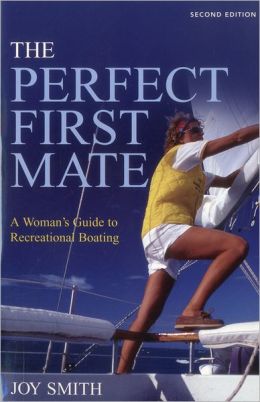
The Perfect First Mate
- image courtesy of Amazon.ca
The subtitle, "A woman's guide to recreational boating," sorta soothes the sting, but, as SWMBO pointed out, when I asked her to help me review this book,
"If I was in a bookstore looking at a choice of books on boating fundamentals, I'd probably pass on this one, just on basic principle."
So I picked it up and read it instead.
(I'm not sure what this says about the equality, or lack thereof, in our personal and boating relationship, but I am sure it says something.)
It's too bad about the unfortunate title, because, if you can get past the cover, you discover there's a lot of solid information packed inside.
Joy Smith brings some solid credentials to the party. A long time boater, Ms. Smith now serves as first mate on a Farr 50, Joy For All, and is a Salty Dawg Rally veteran, with a variety of fiction and non-fiction works under her belt. It quickly becomes obvious she knows her stuff.
Originally published in 1999, The Perfect First Mate is now in it's second edition. Logically laid out, "...First Mate" is loaded wiht good info for the novice boater- The introduction is titled "So You've Bought a Boat." Subsequent chapters demonstrate an exhaustive approach to boating that provides value to more experienced boaters as well, cover everything from stowage to storage to provisioning to pets to hygiene to ...sex.
First mate Smith's writing style is breezy, conversational, comprehensible, and deceptively in-depth; there is little jargon, and the information is clearly presented and easy to understand. For example, want to know how to get rid of mold and mildew and prevent it from coming back? It's in here, and the author explains not just how to deal with it, but what causes it.
The author is a sailor, but the information presented is largely applicable to both sail and power boats.
That breezy writing style is subversive- without directly spelling it out, First Mate Smith makes it clear who really runs a boat... which maybe why a First Mate is often more correctly known as The Admiral
If you've just bought a boat or are considering a boat purchase, this is a good place for new boaters of both sexes to start.
Just get past the cover.
"Talk the Dock!"
Tuesday, 2 April 2013
Book Reviewsday Tuesday: "Cooking Aboard a Small Boat" - A Kinda Cookbook
"Living one word to the next, one line at a time"
-Kenny Chesney
I decided it was time to fill one of the potholes in that nautical information superhighway dirt road that is the Dock Six Chronicles.
We've got Gear and Tool Reviews (to be updated shortly), Recipes (to be updated shortly), Coming Events (yeah, that too needs updating....sigh,) What has been missing until now is a section of Book Reviews.
Today, we solve that problem, kicking off the first...
Book Reviewsday Tuesday!
(*APPLAUSE*)
The plan is to have a new review for you every other Tue..sday.
Some weeks it will be a how-to manual, some weeks maybe a first-hand passage or cruise account, other weeks fiction, sometimes hot off the presses, sometimes an old favourite, sometimes it might not even be boat-related, just a good read I figured I'd pass along.
Your input and help is always welcome- have you read a book you have liked and wish to share, or a book you didn't enjoy and wish to warn others away from? Drop me a line.
One of the things that is great about most boat-related how-to books is that the book title usually tells you exactly what the book is about. No messing about, no having to leaf through the bloody thing in the bookstore to figure out what it's about like some of that fancier stuff. Nope- most marine how-to authors tell you what it's about right on the cover.
Following the norm, Paul "Capt'n Pauley" Esterle gets right to it:
Some of you might be familiar with Capt'n Pauley, thanks to his regular contributions to Small Craft Advisor
magazine.
He's our kinda guy.
Like some of us, Capt'n Pauley sails a small boat- Ternabout, a Matilda 20, one of the great Canadian "trailer sailer" pocket cruisers to come out of the golden age of small boats, the late 60s/early 70s.
Also, like some of us, he has invested an amount of time and money equipping and outfitting that is out of all proportion to the value of his boat.
He understands living large on a small boat.
That Capt'n Pauley knows whereof he speaks was evident from the moment I picked up this book. The binding told me, "This guy gets it."
See, "Cooking Aboard..." is spiral bound.
Spiral binding allows the reader to open the book to the desired page and lay it flat, leaving both hands free to accomplish what you are trying to accomplish by reading the book conveniently lying open in front of you. You can also fold the book back on itself, so that it takes up half the space when opened, a small but important thing when working with limited galley space.
"Cooking Aboard..." is much more "small boat friendly" than typical cookbooks like "The Joy of Cooking", for example. That doorstop would damn near fill Whiskeyjack's galley, and refuses to stay open to any of it's hundreds of pages unassisted.
It's a little thing, but anything that makes my life easier earns bonus points.
As the post title says, this is a kinda cookbook.
And a kinda DIY manual.
And a kinda, well...
"Cooking Aboard..." is what I call a "Start from stupid" book. The author assumes that you know nothing, and aims to teach you everything.
And a kinda DIY manual.
And a kinda, well...
"Cooking Aboard..." is what I call a "Start from stupid" book. The author assumes that you know nothing, and aims to teach you everything.
Occasionally, "Start from stupid" is a bad idea, usually when the author dumbs the book down below the general knowledge level of his/her intended audience, then adopts a narrative style that provides no simple means for the reader to access the information they need now.
Capt'n Pauley avoids this trap by breaking "Cooking Aboard..." into a logical sequence of stand alone chapters and sub-chapters.
For the unconscious incompetent , "Cooking Aboard..." starts from scratch, discussing galley necessities, tools, gear, provisioning and storage, then expands on that foundation by offering advice on galley and cockpit projects to improve the cooking, and eating, aboard experience.
For more experienced galley slaves, it is easy to jump to the sections that have more value, whether it is storage advice, spice tips, recipes or how to build a propane canister locker.
The book is well illustrated, with photos and line drawings illustrating the text of the project under discussion...
.... with a glaring exception- the recipes that fill the last 70 pages of the 182 page book.
While the first 6 chapters are liberally illustrated, Chapter 7 has a only a handful of photos which do little to highlight the recipes to which they are attached. For example, the Chicken Caesar Salad Wraps:
The recipe sounds tasty, but the accompanying image looks like very shiny hand-rolled homegrown of dubious legality.
Many of the recipes are sourced from other sources-books, message boards, forums and other sailors' blogs, which might explain, maybe, the lack of art. But, that in turn, presents another concern- if the author hasn't tried the recipes offered, the author can't attest to the accuracy of proportions, ingredients, or taste. As the first 6 chapters are all based on first-hand experience, I am gonna give the good Capt'n the benefit of the doubt here.
*edit: I contacted Capt'n Pauley with a link to this review. He kindly replied
"Just to be clear, all the recipes were tested, tried and true on Ternabout. I originally had many more pictures of food in the book. However, the cost of a Lulu book is dependent on the binding and number of pages. I knew I wanted the spiral binding even though it is the most expensive binding type. I also wanted as many pictures as I could get in and keep the price of the finished book attractive. Rather than remove pictures of some of the more important features, I removed food type pictures until I got to the price point I was comfortable with."
Thanks, Capt'n for the clarification.
As any good hands-on how-to manual will, "Cooking Aboard..." has a Notes section at the end of the book, which is a handy idea.
There's the odd typo and grammatical error, not uncommon in self-published works, but overall it is a readable, well-presented manual. I expect that my copy will be dog-eared and rum -stained in short order this season, and will be well-thumbed in many seasons to come.
Want a copy of your own?
Fire off a not-unreasonable $17.95 via paypal for the hard copy or only $8.99 for the e-reader version to
Capt'n Pauley at http://www.captnpauley.com/Cooking.html .
You can find the rest of Capt'n Pauley's works on Amazon:
He writes so me good stuff- there maybe more Capt'n Pauley reviews on future Tuesdays.
"Talk the Dock!"
Subscribe to:
Posts (Atom)