Showing posts with label marco and dee. Show all posts

Friday, 29 March 2013

Boat Shopping 101, Part 1: Making the Case for the Wrong Boat

     "Another season passes by you..."
                          -Big Country


   ....  and you are one more season lost, another season spent dock-walking, fender kicking, online ad surfing,  ladder climbing, grinning, nodding, and doing everything but the very thing you need to be doing:

Pulling the trigger on buying a boat.


    If you're still standing on the dirt wishing you were feet-wet, and this condition has persisted more than 26 weeks, do not consult a physician.

   You're simply doing it wrong.

   Those of you who are thinking about buying a boat, a bigger boat, a different boat?

    Quit looking for the right boat.
   
     Find the boat, right now.

     See, here's the deal:

     There IS no "right boat."

     There is, however, a right TIME.

      Now.

      Look, you can spend the rest of your dirt-bound life thinking, wishing, planning, hoping, dreaming, conniving, scheming, fantasizing, about loosening the ties that bind...

     And all of that strategizing still leaves you on the dirt.
 
      Gazing longingly out to sea.
 

     Which is wrong.  Way wrong.


   I'll let you in on a secret:

      Most of us are sailing on the wrong. Damn. Boat.

       That's cool.


      We're sailing.


      *Cue the music*


       Right now.

       Why is "sailing right now" so important, my friends?

        Because no one knows what tomorrow may bring,

        There is a proverb which, in Yiddish, is written:

         .דער מענטש טראַכט און גאָט לאַכט

         Loosely translated, "Man plans, God laughs."


       What has worked for me and for other Docksters may work for you...

... Or  may not, 
    
       ....  and I accept no liability, nor any congratulations, nor any damn thing, incurred along the way.


  But, having said that,

  We are on the water, and you are on the dirt.  

  How's that working out for you?


         Friends of the Dock (henceforth known, anonymously, as FODs) are looking for a boat. 

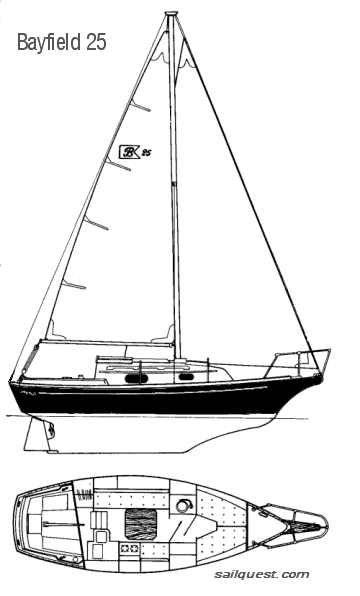
      9 months ago they were looking seriously at a Bayfield 25. 


     They asked me for my advice.

     I offered it:  

      (Come on, you think I am gonna keep my piehole shut?) 

       A Bayfield 25  is a good, solid, capable, full-keeled, well-equipped, comfortable, small cruising boat.  Under $10 K.
  

      Want a cheap, solid $ 4 figure cruiser? 

        The Bayfield 25 is a good bet.

        A boat that would be the queen of Dock Six.

         If it suits them, they should buy it.  

         Others offered the same advice.

       It was the first boat they crawled aboard; conventional wisdom says no one should ever buy the first boat they inspect.

         So, they didn't.


          It sold.

         No problem. 

          It's fall.  Other boats will come along before spring.


         Then, I screwed up.

         I suggested they attend the Toronto Boat Show .

         The FODs climbed all over the big shiny new boats on display.

        They talked to brokers. 
     
        Some good brokers. 
        
         Brokers I trust.  

         Brokers from whom I would buy a boat.

          Brokers who happily and patiently  listened to their needs and wants, and decided that the boat in which they were originally interested, a Bayfield 25, was...

           Too small, too slow, too spartan, too under-equipped.

      
            The Boat Show consensus was, and the shoppers involved agreed, that they needed a newer, more equipped,  big body, big dollar boat...

       ... like walk-through transom Catalina over 30 feet LOA, starting over $80 000.00

     10-15 times as much as the Bayfield 25 that was in their budget and their dreams last season.

          Those brokers who recommended expanding their budget and getting a bigger, plusher, newer, better equipped, more expensive boat aren't wrong...

        If their customer can comfortably write a mid- five- figure cheque for the purchase price...
  

        ....And if the broker and the customer are 100% sure of the customer's needs....

       ...  And if an example  of that "right" boat is available on the market.


          If not?

          Another season lost. 

   
         I argue that the perfect boat for you, (for anybody, for that matter,) is smaller, older, cheaper, slower and uglier than you think it is.


         See these folks?


      Marco  and Dee are less than $3K into their boat.

       Is it perfect?
  
      No.

      Is it their "ideal" boat?

      No.

      Are they out on the water, grinning?  

      Hell, yeah.

      Meanwhile,  waaayy too many other would-be sailors are burning off another season searching for the "right " boat.

      Those of you stupid enough to still be reading, here's what I want you to do:

      Figure out how much you can comfortably write a cheque for, today, right now. 

   Find a boat in 80% of that price range.

     Buy it.

    Now.


    Next post I will explain why.

    Stay tuned.


   In the meantime, 


   "Talk the Dock!"


Tuesday, 6 November 2012

An Ode to Odour

     "We gotta have that funk."
          - Parliament Funkadelic


     Over time, old boat cabins develop a unique scent, an olfactory stew comprised of (more or less) equal parts bilge water, engine oil, fuel, mildew, leaking toe rails, hanging foul weather gear and bathing suits, damp cushions and spilled beer.

      Old Boat Smell clings to all fabrics aboard, including real-world-employment clothes, prompting co-workers to comment that you smell faintly like your boat.

  Truth be told, I like Old Boat Smell.  It smells like....

 Victory.


Note the bold face a few lines back.

  Faintly.  


That is the key to successfully carrying off Old Boat Smell on the dirt.


    If your boat's essence fogs along behind you like a cloud of gulls trailing the wake of a fish tug,  you're doing it wrong.  You want envious dirt-dwellers to note that you smell faintly like your boat, not to faint due to your boat smell.


  The challenge is how to balance on that fine line of funk.

   To keep Old Boat Smell down to socially acceptable levels, the concerned boater has to address ventilation, condensation, moisture intrusion,bilge emulsion, internal combustion emission and probably a whole bunch of other words that end in "ion."

Here is what we have learned over the years.

  Whiskeyjack  is blessed with a surfeit of ventilation.  Cowl vents aft of the mast, a big forward hatch covered by an awning, a fan and a screened companionway door all keep air flowing down below. As we all know, air flow is the way to go if you don't want Old Boat Smell to grow, yo.

I figure ventilation can be divided into two categories:  Passive and active.  Passive ventilation is airflow with assistance, ie vents, while active ventilation is assisted air movement, ie fans. Effective ventilation to prevent the proliferation of odour is ventilation that works all the time, whether the boat is closed up or whether one is aboard, day or night, so to that end passive ventilation is the place to start.

  If you don't have any, or enough, ventilation, add some.  The simplest solution is to slightly crack hatches and ports, but the additional ventilation will mean the introduction of more moisture with the participation of passing precipitation.

It may mean cutting some holes, to install vents.

I like cowl vents.

image courtesy of defender.com


 I really like cowl vents with dorade boxes.


image courtesy of thaiteakmarine.com

Air goes in, but water stays out.


drawing courtesy of Sparkman and Stephens


Simple and effective, cowl vents can be turned to make best use of available breeze, or to provide a vacuum effect- one vent pulls fresh air in, one vent exhausts air from below.

Some folks like solar vents.


     image courtesy of defender.com

   Essentially a low profile vent with a solar powered fan built in, these cowls will move large amounts of air and can be configured as either intake or exhaust fans.  I have no experience with them, so offer no opinion other than to point out that they are twice the cost of old-school unpowered cowl vents.

  Adding louvers or clamshell vents to the companionway hatch is a simple low-buck way to get more air flow.


image courtesy of winterwoodworks.com

Louvers don't have to be fancy to be effective. PVC or stainless louvers are available for under $20


image courtesy of cpyoa

However while companionway louvers are great in all weather to allow air to exit, another inlet vent needs to be installed forward to allow fresh air to enter.

Or, keep the forward hatch cracked slightly, and hang a hatch tent.
You can build your own


or buy one:


image courtesy of defender.com

Air in, rain out, with the added bonus of not waking up when the crack of dawn beams laser-like through the open hatch.


Once you've got air coming in and going out, the next step is to increase comfort by hurrying that air up, by inviting some active ventilation to the party.

There are lots of fan choices out there, some like the Caframo Sirocco...


image courtesy of defender.com
... draw an astonishingly small amount of power.  The Caframo fans are not the cheapest fans on the market but they move a lot of air without a lot of noise at less than .5 amps.  They even have a timer option, and a low battery shut off.  If the cabin on Whiskeyjack was larger, and/or if our sailing season more intemperate, one or more of  these would be at the top of our list.


We have had a low-buck spring clamp- mounted Canadian Tire auto accessory aisle-sourced fan hanging aboard the boat for four seasons.  Seen hiding behind the chartplotter below.


It was on sale for $8, and it still works for the half dozen or so times each season we feel the need to move more air.

Right, then, ventilation is covered.

With air coming in and going out, the next step is to prevent funk-loving moisture from entering.  Chase down the leaks on the boat and this time, do something about them.    Rebed leaking stanchion bases, seal leaking ports, pull and pot grab rails, and cleats and anything else leaking that shouldn't be.  It's a job easier with two people than one, and a great how-to write-up can be found here.

Now, with air passing through successfully, and water unsuccessfully, dry out the bilge and CLEAN.  Clean the bilge, clean the lockers, clean the engine, clean the upholstery, clean the head. Pile everything that can be removed on deck or on the dock.  If it doesn't take you at least half a day, you're either already compulsively neat, or you missed something.
Do this at least once a season.  if you haul your boat for winter like we do, do it at least at splash and haul out.

I'm not going to get into cleaners other than to say that I've tried any number of specialized marine cleaners and found that in most cases  a good household cleaner is as effective and smells better.  In fact, we've discovered that this stuff


...is the best stuff we have ever used for cleaning spider poop.  Spray, wipe, done.


  If you're still with me this far, I'm now gonna break your heart.  

  You've put all this time, effort and money into making your boat impervious to water entry while allowing air to come and go as it pleases...  and you're still going to get moisture on board.  All because of you.  Yes, it's your fault.

Perspiration, respiration, habitation all lead to...

...condensation.

(Hey, look, it's not my fault so many of the damn words in this post are suffixed "ion' I didn't create them, I just have to use them.  Sorry for the frustration.)

In fact, as silly, counter-intuitive and just plain wrong as it sounds, running a heater in cold weather can increase moisture aboard.

How does one solve this phantom unavoidable moisture?

Well, duh.  Add more dryness aboard.

Silica gel.

image courtesy of popularmechanics.com

When you buy a pair of shoes, electronics, furniture, one of these little "do not eat" pouches is invariably nestled somewhere in the box.  These packets are perfect for keeping small lockers, drawers and tool boxes dry. Furniture is often shipped with silica gel bags that are the size of your fist, perfect for keeping v-berths dry.  Tuck them in the corners, or if you want to get fancy, sew little mesh bags to dress them up and hang the packets in the hanging lockers, tuck them on shelves, wherever they will be out of the way.
Stop by your local furniture store and ask for discarded silica gel. Or better yet, come see me and buy some furniture.  Ask for the Dock Six Discount.
Or, you can get all fancy and buy silica gel .

You know what?  Your boat will probably still stink.  Mildew is pernicious stuff, in the words of Vincent Price, "the funk of forty thousand years..."
We've found a really good solution.
Last spring, at Bridge Yachts Open House  I met a representative for Kanberra Gel,

image courtesy of amazon.com

touted as being the bee's knees in boat odour abatement.  I received a sample and mentioned that I would give it a try onboard.
Marco's boat Candy III became the test bench for this evaluation.  His boat had a seriously smelly, Dee-won't-even-think-of-going-in-there -even -after- it- has -been -cleaned mildewy- smelling cuddy cabin.  I gave him the small sample of Kanberra Gel I had received and asked for his feedback.  By small, I mean, small- my sample was a plastic container with a flip top lid about 1" in diameter, about 1/4 ounce.  A few days later Marco invited me aboard his boat and the boat smelled faintly of tea tree oil, not strongly of damp towels. The mildew smell was completely abated for the rest of the season.  I am impressed.  Few products meet the hype attached to them, but Kanberra Gel walks the walk.


Now you know how to turn a sows ear of stink into a silk purse of aroma. Give it a try, and if you have any tips to add, let me know, and don't forget to ...

"Talk the Dock!"


Tuesday, 7 August 2012

I Remain, Sadly, An Idiot.

     "...everything isn't meant to be okay..."
                               -Green Day


             Sometimes, you just gotta acknowledge the ugly truth when it bites you in the ass.
             This is my turn.
             Don't go getting all smug, though, gentle reader...
             It might be your turn tomorrow.

             A funny thing happens when one endeavours to fill a blog with their exploits, opinions and adventures read by thousands hundreds scores a bored handful.  Some begin to think that, you know, the author might actually know what he is talking about, could be considered an expert of sorts, or at least more expert than some readers.


            Just in case any of you are so incredibly naive as to think that I indeed might actually know anything about this whole boating business, let me clarify my position.  Last year I divulged that yes, I am an idiot .
             A year, and 200+ blog posts later,
             I am still an idiot.
             A big, fat, happy, idiot.... but an idiot nonetheless.
             However, I am not a complete moron- I endeavour never to make the same mistake twice, but to always find new ways to screw up.
              This season has been rife with stupid sailor tricks.
             Enjoy the tales of my idiocy, and maybe you can learn something from my experiences.  I did.

                    I built Chirp in 2009, and she has weathered storms, been hauled onto and off docks, cartops, dock carts...

              and now the breakwall.


                         When I first launched her that first season, I tied the painter to the boweye and forgot about it.  Three seasons later, on a mild day with little wind, while tied on the lee side of the Dock,  while I was running errands ashore,  the knot finally worked free, and Chirp quietly, slowly floated across  and gently bumped against the rocks.
                        I got a text message from Ralph that she was adrift, 20th Hole Rick was kind enough to snap the photo above, and within the half hour it took me to return to the Dock, Jack and Melanie had snagged the wayward dinghy and returned her to her rightful place.

                   Lesson learned:  Check all knots daily- you never know when you might need something to stop you when you hit the end of your rope.


                People with too much time on their hands Faithful readers may remember the Solar Shower swan dive covered here last week.

               Lesson learned:  Stow it, or secure it, even if it seems like it doesn't need stowing or securing .  It does.

               Last weekend, SWMBO and I and the compact sportsdawg anchored off the beach for a swim.  When we prepared to return to the Dock, the standard protocol is that I put my bulging biceps and six pack abs to work retrieving the anchor while SWMBO (wo)mans the wheel and guides us toward deeper water and home.  We've never had a problem.

              Until last weekend.

              As I am hauling on the anchor rode, I notice that the anchor chain is no longer ahead of the boat. Rather, the boat seems to be circling the chain.  I yell request that the helmswoman straighten us out, then turn my attention back to getting the ground tackle off the ground and onto the boat.  I  make my way back to the cockpit, observing SWMBO spinning the wheel.  The helm on Whiskeyjack goes lock-to-lock in three turns.  In the time it took me to clamber from the bow back to the cockpit, I watched SWMBO turn the wheel approximately 347 times.

          Obviously, something is amiss.

           Sidling up the SWMBO at the pedestal, I chauvinistically muttered, "Let me try."
           I spun the wheel just as well as she did.

           In technical terms, we have no connection from the spinny wheel thingy on the deck of the boat to the flappy rudder thingy on the underside of the boat,
   
            In other words, we have no steering.

            On a beach.
            With wind and waves picking up.
             And a depth finder reading of 2.9 feet.
             We draw 3 feet.
             Us short fat guys can move when our ass is on the line.  I raced to the bow, tossed the anchor toward deeper water and  hoped it set, then raced back to the cockpit, urged SWMBO to kill the engine, fell into the cabin to grab my tool bag and proceeded to trouble-shoot the problem. Jack, seeing our distress, clambered aboard and we worked it through, with only occasional disconcerting bumps as we bounced off the bottom with the deeper troughs between swells.Starting aft we determined that the rudder was still attached to the boat, the rudder shaft was still attached to the quadrant, the steering cables were still attached to the quadrant, so, for the first time since SWMBO and I became the boat's stewards, (bolding intentional- learn from my ignorance)  we took the compass off the top of the pedestal, and turned the wheel and saw that the wheel was the only thing turning.

          The wheel is secured to the shaft with two set screws.  One was missing and one was a turn or two from being missing.

 
     I tightened the remaining set screw and carefully nursed Whiskeyjack back to the Dock.

     Lesson learned:     If it worked last year, last month, last week, or in the last hour is no guarantee it will continue to work- inspect moving parts more often.  Ignorance is not bliss.  There should be no "first times" when it comes to systems inpsection, after five seasons of boat ownership


    Earlier that day, Gavin has asked me to take a look at his jib furler, which had decided to puke it's halyard.    The plan was to determine whether we could bring the mast down at the dock and solve the issue, so when Marco asked if we could use another pair of hands, I took him up on the offer.  We loaded into Quack and motored over to the Dock Six Annex.  The Yamaha OB banged and sputtered and quit a couple of times, but I figured it was just weeds hung up in the prop.  After sagely examining the mast, the forestay, the furler, the boat across the dock from Sol Antics, wind direction and intensity and Gavin's insurance policy, the decision was made to find another solution.  With that decision made, Marco and I embarked on the return trip.

    Which sputtered to a halt as we entered the main fairway.  Weeds around the prop?  Nope, no weeds around the prop.
Also no gas.

    Quack  is a small lightweight inflatable that is easy to tow and easy to row...by one person.

     With two aboard it is comedy and humiliation.

     Marco bent to the oars,as I tried to stay out of the way, (only because he was already facing aft- I'm not making the newbie a galley slave.  beside, he volunteered.) hauled us across the fairway, and into an empty slip on the Dock, at which point I urged him to flee while I flapped and splashed Quack the rest of the way home...
     But not before Julie managed to get a picture.

     On the bright side, here is photographic proof  I own more than one shirt!

    Lesson learned:  Always top up tank before departure- I'm less likely to get in trouble with a full tank than an empty one.

     Which brings us to yesterday, another day at the beach.  When we anchored the water was calm, but as the afternoon progressed, the wind picked up and the waves followed suit.  By mid-afternoon it was distinctly choppy, with waves of  3-5'.  Most of the boats around us decided to pack it in and head for the safety of sheltered slips.  We, on the other hand, decided that it made more sense to wait it out- usually the wind dies by 6 o'clock, making for a less harried departure, and more relaxed foredeck work.  No point in leaving a secure anchorage if you don't have to, we figured.  We retired to the v-berth to read, and I listened to the reassuring gentle groaning and squeaking  of the anchor rode, pulling against the cleat over my head.

     A few minutes later, the deck noises ceased.

     A quick glance through the forward hatch confirmed the bad news.

     Our anchor rode had snapped.

     Before I went below, I had checked the rode for fraying and chafe where it passed through the cleat, and it was fine.  Now, it quite clearly, emphatically, was not.


     On the upside, this makes our get-the-hell-off-the-beach-right-now procedure much simpler. None of that anchor hauling stuff needed.   Start engine, point offshore, go.

      Except the engine won't start.

     Crap.

     Okay, diagnose it later, let's move to Plan B.  We quickly unfurled the genoa, and sailed ourselves out of trouble.  For now.
      See, we're now off the beach, but to get back to the Dock the wind is going to be on our bow.  Not good. Whiskeyjack is a solid, steadfast, comfortable boat, but she's more of a setter than a pointer.  Getting into the marina is going to mean several tacks across a busy channel. Not a great plan.  Better get the engine running.  A quick seat-of-the-pants diagnosis is lack of fuel.  I usually change the fuel filter every spring, but had put it off this season for no good reason.  It appears that that decision has now come back to haunt me.  With some cranking and cracking the fuel filter bowl to drain the crap in there and more cranking we managed to convince our little Yanmar to run, and we returned to the Dock with no further excitement.

     Lessons learned:  Oversized rode is better than rode that is just big enough, chafe gear is a good idea even if you are anchoring on a sunny day for an afternoon swim, and maintenance deferred is disaster awaiting.

   Tomorrow is my day off, and rather than sailing, I am declaring a maintenance day.  Whiskeyjack and Chirp and Quack and Legacy deserve some attention.  My barrel of luck might be running dry, and my cup of experience is nowhere near filled yet.


"Talk the Dock!"
Wednesday, 1 August 2012

New Crew Review


     "I haven't yet, but there's still a chance I might..."
                              -The Mighty Mighty Bosstones


     When dirt-folks discover that I am a sailor, I often hear, "Oh, I have always wanted to sail! I'd like to sail sometime!  How do I get started sailing?"
      Huh?
    I mean, nobody ever asks, "How do I get started golfing?"  or "How do I get started jogging?"  You just show up.

    So, in an effort to get more folks like us involved, I'm going to let everyone in on the secret.

    Ready?

    Come on down the Dock.  
    Or any dock where you see masts.
    Bring rum.
   You're in.

   Nobody is more happy to show off their boat or have new crew than sailors. 
   Especially me.  
   See, greenhorns have no idea  how a boat is supposed to sail or look  or what proper sail shape looks like, so they have no idea just what a hack I am.

   (It occasionally drives SWMBO nuts when I press-gang strays without notice, but she is great at rolling with the punches, and finding a way to stretch a half box of crackers and a stick of cheese into snacks for four.)


  The month started off with an afternoon aboard with SWMBO's bosses, Lyn and Leigh.  This is the first time I had spent any time with them...
.... and the first time they had spent any time with me.
I admire my wife for having the courage to throw her career prospects to the winds.
(Hey, it's that or wonder WTF she was thinking.)

It was a rough day, rougher than we'd like for sailing with newbies, so we simply soaked up the atmosphere on the Dock, and  talked about boats and sailing and life in general and met some of the other characters, and generally proselytized like boat missionaries.

Gavin and Sylvia made a guest appearance and added a couple of hallelujahs and amens.


  It worked.  Lyn and Leigh spent the next few days scouring the classified ads looking for boats, and the next weekend they inspected a Bayfield 25 for sale here in the Marina...  and brought dinner.  And rum.
And we brought Jack and Melanie to further sink the hook.


  Lyn and Leigh will be hull-wet by the beginning of next season.

A couple of weeks later Leigh came out for a sail, and we shanghai'd Ed into joining us.  The wind wasn't heavy but the Bay was choppy.  So choppy that we managed to break some of our high quality polycarbonate  dinnerware.  Yes, Virginia, you can break stuff at 3 knots.

A  couple of weeks ago I bought a solar shower to test and review.  Basically it is a black 5 gallon bag of water with a hose.  To use, you fill the bag with water, leave it in direct sunlight and a few hours later, you have warmish water.  The best only place on Whiskeyjack  to lay a solar shower is atop the cabin.  
What does this have to do with newbies?

Last weekend Marco and Dee came aboard.  Neither had sailed before, but both were enthusiastic.  The wind was optimal, so we  set out.   With detailed instruction, the newbs hoisted main and unfurled the genoa and trimmed the sails and we were moving!
As we heeled to 30 degrees, I realized that the forgotten solar shower  had been neither stowed nor secured. It walked across the cabin top like a water-filled slinky, flip, flip, flip, and then FLOP! jumped over the side.

Retrieval was a non-starter as it was quickly lost to sight in our wake.

That was the only mishap of the afternoon and we had a great sail.  Marco enjoyed himself and really "got it."...


   ...but Dee is well and truly HOOKED.  Marco and Dee are apparently going to be sailboat shopping soon.


  So, how do you start sailing?  Go where the masts are.  Bring rum.  Soon you'll be grinning too.

And "Talk the Dock!"